
For building owners and property managers
Commercial Roofing Contractors in King of Prussia, PA
Office, retail, and apartment buildings in King of Prussia often have flat or low-slope roofs. This page explains how these roofs fail and how to make smart repair and replacement choices.
Short answer: most commercial leaks start at seams, penetrations, rooftop unit curbs, and drains. Start with an inspection that documents the whole roof, then decide on repair, recover, or replace.
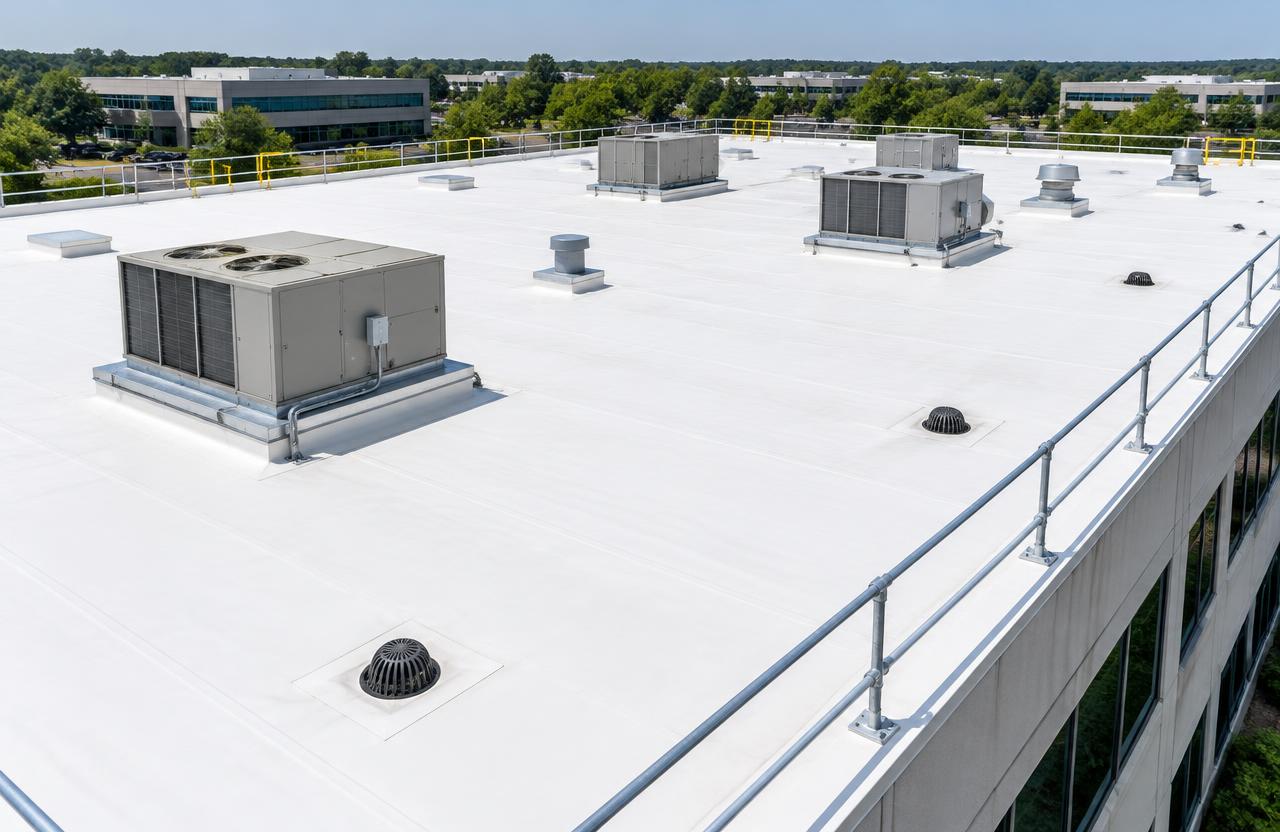
Low-Slope Roofs Are Different
A low-slope roof looks flat, but it is built with a small slope so water can drain. Instead of shingles, it uses a sheet called a membrane. Water moves slowly on these roofs, so small openings matter more.
This site sends commercial requests to one local partner roofer. Tell us the building type and the problem, and coverage is checked for the address.
Common Membrane Types: TPO and EPDM
Your roofer should tell you what system you have. Each one fails in its own way.
TPO
A single-ply membrane, often white. Seams are heat-welded. Watch for seam separation, punctures, and worn spots near walkways.
EPDM
A rubber membrane, often black. Seams are taped or glued. Watch for seam lifting, shrinking at edges, and splits.
Modified bitumen
Layered asphalt sheets. Watch for cracks, blisters, and worn top surface.
Not sure?
That is fine. The roofer can identify the system during the inspection.
Rooftop Units and Penetrations
Rooftop HVAC units sit on curbs. Pipes, vents, and conduits go through the roof. Every one of these is a place where the membrane must be sealed around something.
These spots move, get stepped on by service crews, and see heat from equipment. They are some of the most common commercial leak sources. Keep a walkway path to units and ask service crews to report damage.
Drainage and Ponding Water
Ponding is water that stays on the roof long after rain. It can speed up wear, add weight, and find small openings.
Check drains, scuppers, and gutters for leaves and debris. If water keeps pooling in the same spot, the roofer can check whether drains are clear and whether the slope or insulation needs correction.
Think You Found the Problem?
Send us what you're seeing.
- 1Enter your ZIP
- 2Describe the problem
- 3Add roof photos
- 4Get connected with the local roofing partner for your area
Leak Tracing on Commercial Roofs
On a low-slope roof, water can travel under the membrane or through wet insulation before it drips inside. The drip may be far from the opening.
A good inspection maps the leak location inside, checks seams and penetrations above it and upslope, and looks for wet insulation. Some roofers use moisture scans to find wet areas. Ask how they will find the source.
Repair vs. Recover vs. Replace
These are the three main choices. The right one depends on the roof's condition, not a sales goal.
Repair
Fix seams, flashings, and penetrations when the rest of the roof is sound and dry.
Recover
Add a new roof over the old one when allowed, when the old roof is mostly dry, and when layer limits allow it.
Replace
Remove the old roof down to the deck when there is widespread wet insulation, many failures, or too many layers.
Coatings
Some roofs are candidates for a restoration coating. The roof must be in good enough shape for this to work.
Maintenance and Documentation
Property managers need records. Good records help with budgets, warranties, and insurance.
- Inspect the roof at least once a year and after big storms
- Keep photos of each inspection, labeled by date and area
- Log every leak with location, date, and weather
- Clear drains and remove debris on a schedule
- Track repairs and who did them
- Keep warranty papers and follow their care terms
What Building Owners Should Ask
Use these questions when you meet a commercial roofer.
- What roof system is this, and how is it attached?
- Is there wet insulation, and how do you know?
- Can this roof be repaired, recovered, or does it need replacement?
- How will you protect tenants and operations during work?
- What safety setup will your crew use on the roof?
- What will the written report and photos include?
Straight answers
King of Prussia Commercial Roofing Questions
Do you handle TPO and EPDM roofs?
Requests for TPO, EPDM, and other low-slope roofs are welcome. The roofer will confirm the system at inspection.
Can my roof be recovered instead of replaced?
Sometimes. It depends on how wet the old roof is, the number of layers, and local rules. An inspection decides.
Why does my roof leak near the HVAC unit?
Curbs and penetrations are common leak points. Seals can fail from movement, heat, and foot traffic.
How often should a commercial roof be inspected?
Many owners inspect at least once a year and after major storms. Your warranty may have its own terms.
Can you give a written report?
Ask for a written report with photos as part of the inspection. It helps with budgets and records.
Get a Clear Answer for Your Roof
Tell us what you see. One local partner roofer serving Pottstown will follow up to look at the roof and explain the exact scope and price.